

Introduction: What Does Primary Education Mean?
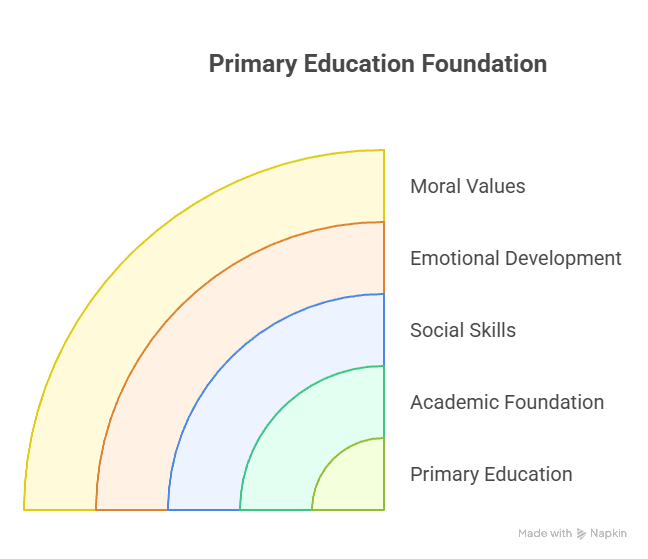
Primary education is the first and most critical stage of formal schooling in a child’s life. It lays the academic, social, emotional, and moral foundation on which all future learning is built. When parents search for primary education meaning, they are not only looking for a dictionary definition—they are seeking clarity on which classes are included, what children learn, why this stage matters, and how it shapes long-term success.
In India, primary education holds special importance because it is recognized as a fundamental right under the Right to Education (RTE) Act. At Scholars Paradise International School, primary education is designed to go beyond textbooks, combining conceptual learning, smart classrooms, value-based education, and individual attention to help every child thrive.
This comprehensive guide explains the meaning of primary education, its structure in India, class-wise breakdown, comparison with other education stages, and why choosing the right primary school plays a decisive role in a child’s future.
What Is Primary Education? (Simple Definition)
Primary education refers to the first stage of formal education that children receive after preschool or pre-primary schooling. It focuses on developing:
- Basic literacy (reading and writing)
- Numeracy (mathematical understanding)
- Communication skills
- Social behaviour and discipline
- Moral values and life skills
In simple terms, primary education teaches children how to learn, not just what to learn.
Primary Education Meaning in India
In the Indian education system, primary education typically includes Classes 1 to 5, while Classes 6 to 8 are referred to as upper primary. Together, they form what is known as elementary education.
Legal Framework
- Governed by the Right to Education (RTE) Act, 2009
- Makes education free and compulsory for children aged 6–14 years
- Applies to both government and private schools
Purpose of Primary Education in India
The primary education system in India aims to:
- Build a strong academic base
- Reduce dropout rates
- Encourage inclusive education
- Prepare students for upper primary and secondary education
Which Classes Are Included in Primary Education?
This is one of the most searched questions related to primary education.
Primary Classes Explained
- Lower Primary: Classes 1 to 5 (Ages 6–11)
- Upper Primary: Classes 6 to 8 (Ages 11–14)
Although many people use the term “primary” for Classes 1–8, technically:
- Primary education = Classes 1–5
- Upper primary education = Classes 6–8
Lower Primary Meaning
Lower primary refers to the early years of primary schooling, usually Classes 1 to 3.
Focus of Lower Primary Education
- Reading and writing skills
- Basic mathematics
- Introduction to environmental studies
- Classroom discipline and routines
- Learning through activities and interaction
Lower primary education acts as a bridge between preschool and structured academic learning.
Upper Primary Meaning
Upper primary education includes Classes 6 to 8 and represents a transition from general learning to subject-specific education.
Key Characteristics of Upper Primary
- Separate teachers for different subjects
- Introduction to science, social studies, and advanced mathematics
- Development of analytical and critical thinking
- Preparation for secondary education
Is Class 6 Primary or Secondary?
Class 6 is not secondary education. It is part of upper primary education.
Education Level Breakdown
- Classes 1–5: Primary
- Classes 6–8: Upper Primary
- Classes 9–10: Secondary
- Classes 11–12: Higher Secondary
Is Class 7 Primary or Secondary?
Class 7 belongs to upper primary education, not secondary.
Is Class 8 Primary or Secondary?
Class 8 is the final year of upper primary education and serves as a foundation for secondary schooling.
Below Primary Education Meaning
Below primary education refers to pre-primary or preschool education, which comes before Class 1.
Below Primary Classes
- Nursery
- LKG (Lower Kindergarten)
- UKG (Upper Kindergarten)
This stage focuses on play-based learning, motor skills, language exposure, and emotional development.
Structure of Primary Education
Understanding the structure of primary education helps parents make informed decisions.
Primary Education Structure in India
| Stage | Classes | Age Group | Focus |
|---|---|---|---|
| Below Primary | Nursery–UKG | 3–5 | Play-based learning |
| Lower Primary | 1–5 | 6–11 | Literacy & numeracy |
| Upper Primary | 6–8 | 11–14 | Subject mastery |
| Secondary | 9–10 | 14–16 | Board exam preparation |
Primary Education Curriculum Overview
The primary education curriculum is designed to support holistic development.
Core Subjects in Primary School
- English
- Mathematics
- Environmental Studies (EVS)
- Science (upper primary)
- Social Studies
- Regional Language / Hindi
- Computer Education
- Art, Music, and Physical Education
At Scholars Paradise International School, the curriculum follows ICSE standards, enhanced with smart classes and activity-based learning.
Importance of Primary Education
Primary education is often called the foundation of lifelong learning.
Why Primary Education Is Important
- Builds strong academic fundamentals
- Shapes behaviour and discipline
- Encourages curiosity and creativity
- Develops communication and social skills
- Instills moral values and confidence
Research consistently shows that children who receive quality primary education perform better academically and socially in later years.
Primary Education vs Preschool Education
| Aspect | Preschool | Primary Education |
| Age | 3–5 years | 6–11 years |
| Learning Style | Play-based | Structured academics |
| Objective | School readiness | Academic foundation |
| Outcome | Basic skills | Literacy & numeracy |
Primary Education vs Secondary Education
| Aspect | Primary | Secondary |
| Classes | 1–5 | 9–10 |
| Focus | Basics | Exams & specialization |
| Teaching | Guided | Subject-oriented |
| Goal | Foundation | Career preparation |
Role of Primary Education in Child Development
Primary education influences:
- Cognitive development
- Emotional intelligence
- Social interaction
- Ethical understanding
- Physical well-being
A positive primary school experience builds confidence, curiosity, and resilience.
Why Choose Scholars Paradise International School for Primary Education?
Scholars Paradise International School offers a balanced primary education program that integrates:
- ICSE curriculum
- Smart classroom technology
- Experienced and trained teachers
- Small class sizes for individual attention
- Value-based and character education
- Multiple branches across Lucknow
Our approach ensures children are academically strong, morally grounded, and future-ready.
What is the meaning of primary education?
Primary education means which class in India?
What is primary level education?
What is the structure of primary education in India?
Lower Primary: Classes 1 to 5
Upper Primary: Classes 6 to 8
Together, these stages are also referred to as elementary education.